Company will transport around 3,300 TEU of cargo using shipping line’s biofuel-powered services between Asia and Europe
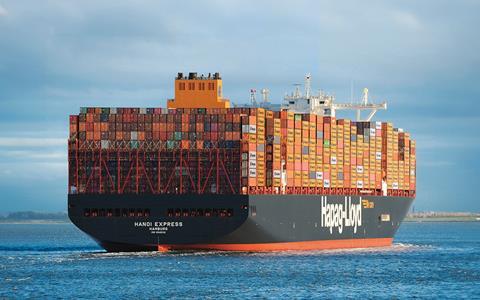
Freight forwarder Kuehne+Nagel says it will start using Hapag-Lloyd’s Ship Green shipping services, which are run on lower-emission fuels, as the two companies look to strengthen their long-standing partnership.
From April to December 2026, approximately 3,300 TEU of cargo transported on the line’s East Asia to North Europe trade lane will apparently be covered under the agreement.
Through the use of certified waste- and residue-based biofuels, the companies expect the initiative to avoid around 2,979 tonnes of CO₂e emissions on a well-to-wake basis.
“We are proud to take our partnership with Kuehne+Nagel to the next level,” said Danny Smolders, global sales managing director at Hapag-Lloyd. “With Ship Green, we offer a scalable solution that enables our customers to actively reduce their Scope 3 emissions today. This agreement shows how strong partnerships can translate into tangible climate impact.”
Paolo Montrone, head of trade global sea logistics at K&N, added: “Decarbonising shipping requires transparency, collaboration and commercially viable solutions. By having strong partnerships, making emissions data transparent, and enabling scope 3 reductions, we help customers navigate in a credible, market-based way, designed to accelerate the uptake of alternative fuels. We are pleased to extend our collaboration with Hapag-Lloyd to make this come true.”
The agreement is based on a book-and-claim chain-of-custody mechanism that allows customers to claim verified emission reductions, regardless of the physical fuel allocation to specific vessels or routes.
Only emissions reductions from biofuel that has been used in Hapag-Lloyd’s operated fleet is allocated to K&N.
According to K&N, the model enables scalable climate action, utilizing waste based biofuel as a so-called “bridge solution”.
Both companies say they are committed to ambitious climate goals. Hapag-Lloyd aims to achieve net-zero fleet operations by 2045, while K&N has committed to reaching net-zero emissions by 2050.