German cooperative says group-wide efficiency drive will help deliver improvement amid challenging market conditions
German cooperative Landgard has revealed that sales in its fruit and vegetables division fell by 13.4 per cent to €415m in 2025.
Overall, the group generated sales of €1.7bn last year and returned a positive pre-tax result, despite continued challenges across the market.
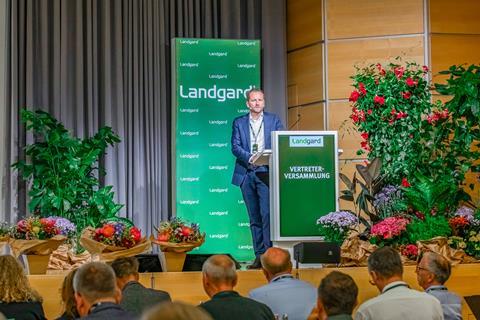
Announcing the results at its annual assembly earlier this week in the presence of a new executive board that featured CFO Moritz Krannich and board member Christoph Klöpper, the group said total sales were down by €100mn on the previous year’s figure.
However, it said a “comprehensive” optimisation process, active cost and energy management, and structural adjustments had helped it to achieve earnings before tax of €3.3mn.
Gross margin also improved, it noted, rising from 12.0 per cent in 2024 to 12.5 per cent in 2025.
In his opening address, supervisory board chairman Bert Schmitz welcomed the newly elected members of the representatives’ assembly.
“Landgard, like the entire green sector, faces major challenges because the market is changing at great speed,” he said. “We are responding to this with our future programme, Landgard Nova, through which we are fundamentally transforming and further developing Landgard.”
Costs and consolidation
Landgard attributed the decline in its fresh produce business to consolidation and structural adjustment effects within the group.
The division has apparently focused on optimising processes to improve efficiency, redesigning service processes, and further harmonising and optimising its ERP provision.
“Rising costs, restrained consumer spending and increasing consolidation are shaping competition,” said management board member Moritz Krannich. “At the same time, digitalisation, changing customer requirements and more volatile weather conditions are driving market dynamics. These developments affect the entire sector – and therefore us as well.”
He continued: “This is not entirely new and Landgard has already gone through many periods of change. But the pace and impact of external developments are becoming ever greater. That is why we, too, must fundamentally change in many areas – technologically, structurally and culturally.”
According to Landgard, Nova aims to make the cooperative simpler, leaner and more effective through a clear focus on digitalisation, efficiency and customer-oriented solutions.
“On the one hand, this affects our business divisions, which we are sharpening and developing further in a targeted way,” said Christoph Klöpper. “In the flowers and plants division, we are bundling and centralising important processes, creating even clearer offerings and thereby increasing scalability. In the fruit and vegetables division, on the other hand, we are specifically strengthening the regions, expanding regional expertise and services, and moving closer to growers and customers.”