Exports declined 4 per cent to 12mn tonnes in 2025, with Fepex citing rising costs and competitive disadvantages versus third countries
Spanish exports of fresh fruit and vegetables decreased by 4 per cent in volume compared to the previous year, totalling 12mn tonnes.
Data from the Department of Customs and Special Taxes, published by the Ministry of Economy, Trade and Business and processed by Fepex, showed that the country’s fresh produce exports increased by 4 per cent in value year-on-year, up to €18.67bn.
Europe was the main destination, accounting for 97 per cent of the total, in a year in which fresh produce imports into Spain grew by 3 per cent in volume and 8 per cent in value.
Fepex said that the export volume decline was the result of “multiple factors”, highlighting higher production costs as well as decreased competitiveness when compared to third countries.
Vegetable-driven decline
The decline in export volume was mainly attributed to vegetables, which saw a 7 per cent decrease compared to 2024 to 5.3mn tonnes.
Vegetable value remained relatively stable at €8.17bn, slight growth of 0.4 per cent.
Fepex pointed out that the decline in exports of ”products of great sectoral and social importance”, such as tomatoes, was ”particularly noteworthy”.
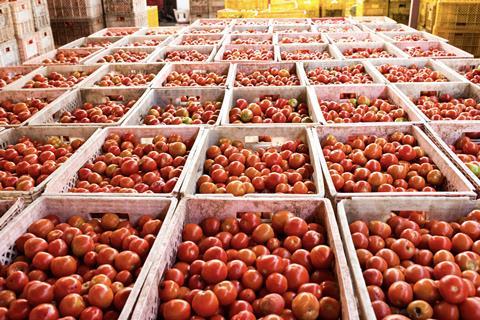
Tomato exports endured a 15 per cent decrease in volume, coming in at 581,361 tonnes, and a 5 per cent drop in value to €1.05bn, it reported.
Lettuce saw a fall in volume and stable value, coming to 740,258 tonnes and €954mn respectively, while cabbage volume dropped 2 per cent in volume and value, totalling 515,530 tonnes and €771mn.
Fruit value rises
Fruit exports experienced a slight year-on-year decrease of 1 per cent in 2025 to 6.6mn tonnes, while value grew by 6.5 per cent to €10.5bn.
Citrus remained the most-exported fruit, Fepex said, followed by watermelon, a category that saw foreign sales grow 3 per cent in volume and 8 per cent in value to 820,611 tonnes and €604mn respectively.
Stonefruit experienced declines in export volumes but improved in value terms year-on-year.
Exports of nectarines fell 2 per cent to 332,831 tonnes but soared 16 per cent in value to €577mn, a trend also seen in flat peaches, with 185,142 tonnes exported (down 9.5 per cent) at €349mn (up 10 per cent).
Strawberries remained one of the most exported fruits in 2025, with 265,182 tonnes sent (up 1 per cent) at a value of €871mn (up 8 per cent).
EU still on top
By destination, the EU remained the primary market for Spain’s exports, taking in 10mn tonnes or 84 per cent of the total.
This percentage climbed to 97 per cent when the UK and other European countries were included, resulting in exports to Europe of 11.7mn tonnes.
By contrast, exports to non-European countries came in at 316,772 tonnes, a drop of 14 per cent when compared to 2014.
”This decline is a consequence of the protectionist policies of many of these countries and the complexity of negotiating the phytosanitary protocols required to open their markets,” Fepex stated.
In terms of value, Spanish exports to the EU reached €15.25bn, an increase of 5 per cent.
Exports to Europe as a whole reached €18.19bn, 4 per cent high than 2024, while sales outside Europe reached €478mn, tumbling 11 per cent year-on-year.
Imports of fruits and vegetables in 2025 registered year-on-year growth of 3 per cent in volume and 8 per cent in value, reaching 4.7mn tonnes and €5.477bn respectively.
Fruit imports came to 2.4mn tonnes (up 5 per cent) and €3.849bn (up 11.5 per cent), while vegetable imports reached 2.3mn tonnes (up 0.5 per cent) and €1.63bn (up 0.5 per cent).
Competitive disadvantages
”The projected decline in fresh fruit and vegetable exports in 2025 is the result of multiple factors, most notably increased production costs and decreased competitiveness compared to third countries,” Fepex outlined.
”Differences in phytosanitary, labour, and social standards established in EU legislation, which are not required in the third countries of origin of imports, create competitive disadvantages.
”Furthermore, the concentration of sales within the EU demonstrates the importance of this market for the sector and, therefore, the significance of all the measures promoted by the European Commission,” it continued.
”In this regard, Fepex is calling for a trade agreement policy with third countries that includes reciprocal measures and a Common Agricultural Policy (CAP) that maintains the importance of fruit and vegetable producer organisations, provides them with sufficient resources, and prioritises EU production.”