
Blue Whale’s commercial director Marc Peyres argues for eating quality to be prioritised over provenance as apple consumption falls in various European markets
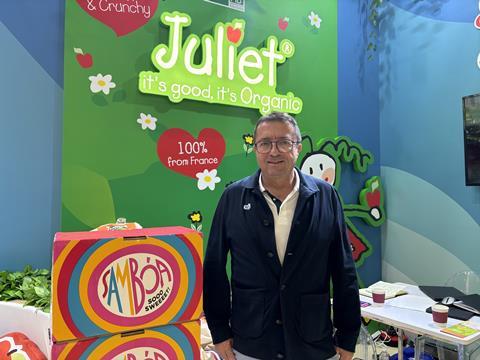
French apple exporter Blue Whale believes rising demand for local apples across Europe in the last two years has harmed total consumption, with an overemphasis on supplying domestically grown rather than high-quality fruit that drives repeat purchase.
Commercial director Marc Peyres told Fruitnet that this has been a trend across a number of European countries, including France, Belgium, Germany and the UK – Blue Whale’s biggest export market.
He argued for supply chains to “pay more attention to the eating quality of apples than their nationality”. However, Peyres did not blame retailers, but rather the industry as a whole.
“Retailers have pressure from the press, growers, trade bodies, so they have no choice,” he said.
“This is not against UK apples,” Peyres stressed. “It’s happening everywhere. I think there are some very good British apples, but not all of them. And in France and other European countries I believe the same. In the end, if consumption goes down, we are all losing.”
His comments follow a decline in per-capita apple consumption in Spain, Belgium, the Netherlands, Germany, Austria and Italy in 2025 compared with the 2022-2024 period, according to AMI figures. The decline was particularly marked in Italy.
In the UK, meanwhile, volume sales of apples decreased by 2.5 per cent in the year to 17 May, according to Worldpanel data published in the FPJ Big 50 Products 2026. This followed a 6.4 per cent increase the year before.
Peyres emphasised the need for varietal renewal across Europe to replace old varieties – such as Golden Delicious, which remains the highest-volume apple variety in Europe – with newer cultivars that he believes offer superior eating quality.
In the UK, Peyres says supermarkets are now “ready” for a varietal shake-up, which was “maybe not the case five years ago”.
Two varieties that he believes have strong potential for the UK market are Candine (a bi-coloured premium, sweet and crisp apple developed in France as a cross between the Fuji and Ariane varieties) and Sambóa (a trio of varieties described as very sweet, juicy and crunchy, with a long storage life).
Ali Capper, the executive chair of UK industry body British Apples and Pears, responded to Peyres’ comments by saying: “Quality and provenance are not competing priorities. Eating quality is fundamental to encouraging repeat purchase and British apples deliver consistently on exceptional quality and eating experience. We also know that British shoppers are passionate about British apples because they say so on all our social media channels.
“British apple eating quality is evidenced by the sales of British apples by our members to UK supermarkets which reached record breaking levels in the first nine months of the 2025/26 season, nearly five per cent ahead of the previous year.
“The priority for the whole category should be to work together on quality, availability, value and strong in-store presentation so that more consumers choose apples more often.”