Expert speakers at Fruitnet Berry Congress, which took place in London on 19 March, highlighted the potential of various technological solutions to address issues surrounding labour, energy, quality and waste in the berry category
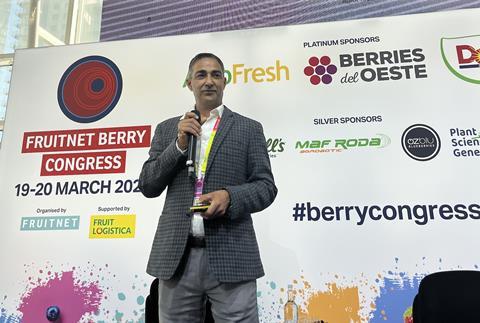
The key to achieving consistent quality in the berry segment is not about implementing technology, according to Malkeet Padda of US-based post-harvest solutions company AgroFresh, nor is it about collecting more data. “It’s really about connecting the dots,” he told a packed crowd at Fruitnet Berry Congress in London during a session focused on technology. “We have our FreshCloud software which helps to do this. You have to connect the dots all the way from the breeding side to the retail store.”
Most of the losses in the supply chain are no surprise, he said. “They are predictable,” he explained. “The thing is that we are not connecting the signals early enough in the supply chain to predict those quality losses, which happen late in the chain. In the end, the variability in the quality of berries is not really a biological problem, it’s a system issue.”
Sid Shaikh of FieldWork Robotics spoke of the potential of robotic berry pickers to address labour issues. “Berry growers are facing rising labour costs, which impact their margins,” he said. “There are also significant shortages, which mean that berries either get picked at the wrong time or don’t get picked at all. Our robots work collaboratively with humans. Our aim is for the cost of harvesting a kilogram of raspberries to be lower for a robot-human picking team than for a purely human team.”
The company has run successful trials in Portugal, the UK and Australia, according to Shaikh. “Later this year, we will build our version 3 production robots,” he revealed, “and then in 2027/28 we’ll build our final hardware incarnation of the robot. After that, all performance improvements will be based around software. We want to support the UK in remaining competitive in berry harvesting.”
Intelligent Growth Solutions (IGS) develops modular, automated growth towers that create biosecure environments for plants, with a current focus on strawberries. These systems precisely control light, temperature, humidity, CO2 and nutrients, while sensors and cameras enable real-time monitoring and AI-driven insights.
“The tower itself provides the ideal conditions for plants to grow,” the company’s Gina Mercier explained. “Up to 40 per cent of starter plants can carry pathogens, transport accounts for roughly half of plant costs, and as many as 30 per cent of seedlings can’t even be planted. This is where we believe our technology can be really helpful.”
Energy remains the critical factor, Mercier noted said. “The key input cost is energy,” she said, stressing the importance of careful financial modelling to ensure viability. “Our UK-based project demonstrates this approach. Located in Essex, the development pairs vertical towers with glasshouse production and a nearby energy-from-waste facility, producing stable, low-carbon power. This is really exciting, quite transformative for creating propagation 365 days of the year.”
For OneThird, the goal is to reduce waste and optimise shelf-life, according to the company’s Marco Snikkers. OneThird’s solution is a non-destructive optical scanning system that uses light to measure the entire fruit. “This allows far more samples to be tested than the common refractometer tool,” said Snikkers, “producing a statistically robust average. Now you have a system which doesn’t have to be calibrated, doesn’t have to be cleaned, and the fruit doesn’t have to be cut.”
But the real value lies beyond the device itself. “We’re not really selling a scanner,” he says, “we’re trying to provide actionable data.” Results are uploaded to cloud-based dashboards, offering real-time insights into batch quality, variation and trends across farms or varieties. “Looking ahead,” he added, “spectral imaging could analyse entire punnets in a single scan, bringing the industry closer to testing every item, not just a sample.”