Global CMO Jiunn Shih discusses leadership changes, legal challenges, and the way ahead for a company in the eye of a storm
Jiunn, let’s start with the people side of the business. There have been several senior leadership changes at Driscoll’s in the past 12 months, including most recently the appointment of Brie Reiter Smith to succeed Soren Bjorn as CEO. In effect, have we witnessed a restructuring of the company?
Jiunn Shih: What we’re seeing is a company that has been very intentional about strengthening its leadership team as the business continues to expand globally.
Driscoll’s is no longer simply an American business. We are truly a global business. As a result, we have brought in leaders with diverse backgrounds and perspectives. I came from Zespri and consumer packaged goods. Our CFO Wadih Khayat came from Coca-Cola. Wyard Stomp expanded his responsibilities after serving as president of EMEA and is now chief operating officer.
This is not a restructuring in the sense of a fundamental change to the organisation. It is the natural evolution of a company strengthening its capabilities during a period of significant growth as it becomes increasingly global.
Brie Smith’s appointment is clearly a major change. Is her appointment likely to lead to a shift in strategy?
JS: Last week, after her appointment was announced, Brie held a town hall with employees. She was very clear that this is about continuity.
Soren is supporting the transition, and Brie herself already helped shape the long-term strategy in her role as vice-chair of the board. Her appointment reflects a continued commitment to that strategy and our mission.
One of the things that has impressed me most since joining Driscoll’s is how deeply embedded the mission is in everything we do. We begin presentations by discussing our mission: continually delighting berry consumers through alignment with customers and growers.
Brie has lived that mission her entire life. She also brings both governance and management experience. Beyond her board responsibilities, she most recently served as vice-president of product leadership for the Americas. She understands both governance and day-to-day management.

“No system is perfect, and we are always looking for opportunities to improve.”
She is also stepping into the role at a time when Driscoll’s faces some serious legal and regulatory challenges. One allegation suggests there was an attempt to conceal food safety issues. How does the company view these cases?
JS: Because these are active legal matters, I’m limited in what I can say regarding specific allegations. What I can say is that Driscoll’s takes questions about safety and compliance extremely seriously. Food safety is fundamental to our business.
We have multiple layers of oversight, including third-party certifications, grower requirements, residue testing programmes, water safety protocols, and independent audits.
We require our independent growers to comply with all applicable regulations in the markets where they operate.
Driscoll’s stands behind its food safety programmes and its commitment to delivering berries that are safe, high quality, and enjoyable. When issues are raised, we investigate them and continually look for ways to strengthen our systems.
No system is perfect, and we are always looking for opportunities to improve.
Are you saying there are lessons to be learned?
JS: There are always opportunities to improve. But we stand firmly behind the rigour of our food safety programmes and the standards we require throughout our grower network.
Are you able to address any of the specific allegations?
JS: What I can say is that the consumer lawsuits do not allege that Driscoll’s berries were unsafe, exceeded regulatory limits, or involved unlawful pesticide use.
We take questions about safety seriously, but we also recognise that consumers increasingly want to know more about how food is grown. Driscoll’s welcomes that interest and scrutiny.
One lesson for us is that we need to do a better job explaining how our berries are grown and how our safety systems work. We cannot assume consumers understand agriculture. We must continue earning trust through transparency, education, and evidence.
How damaging have these recent controversies been?
JS: Internally, they have had a significant impact on our growers and employees because the narrative being circulated does not reflect the company they know and work for every day. It has been difficult to see Driscoll’s portrayed in ways that do not align with reality.
We are also mindful that misinformation, particularly on social media and in some cases AI-generated content, can spread rapidly. That reinforces the need for us to communicate more effectively about our food safety programmes and the investments we make to ensure our berries are safe.
Critics argue that Driscoll’s is a brand that reaps all the rewards while growers take on all the risks. What do you make of this?
JS: Our business succeeds only when growers succeed. The Driscoll’s model in the Americas is built on partnerships with independent growers. We are not a company-owned farming operation.
Growing berries is complex, and our model is designed to support independent family farms. Growers focus on farming and harvesting. Driscoll’s focuses on breeding, agronomic research, food safety, quality systems, distribution, sales, and marketing.
Together, we create value that neither can create alone. Growers receive between 70 per cent and 90 per cent of the net value of the fruit. And, importantly, growers are not locked into long-term arrangements. They can decide each season whether to continue growing Driscoll’s varieties.
Many have chosen to do so for decades, and in some cases across generations. To me, that is strong evidence that the partnership works.
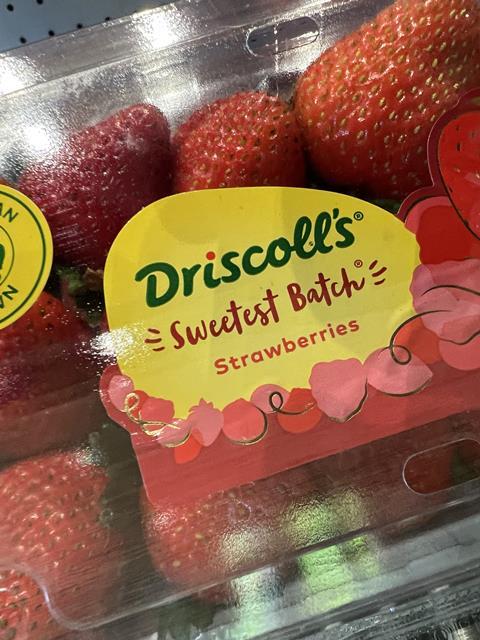
One other criticism, raised in a recent report, is that large-scale, year-round production sacrifices flavour. Is there any merit in that argument?
JS: I think that argument conflates two separate issues. There is absolutely value in small, local, speciality growers, and we believe healthy competition is good for the category.
But when it comes to quality, flavour is the first trait we breed for. It comes before yield and appearance because delighting consumers is central to our mission. We test hundreds of varieties every season to improve flavour.
Of course, taste is subjective, and consumers have different preferences. But the idea that scale has replaced flavour and quality as our priority simply does not reflect reality.
I also wanted ask about the recent US anti-dumping investigation involving Mexican strawberries. What is the company’s position on this?
JS: This remains an active trade matter, so I cannot comment in detail. What I can say is that consumers want great-tasting strawberries year-round, and Driscoll’s has spent decades building a year-round supply system to meet that demand. Regardless of how the case develops, our commitment to serving consumers remains unchanged.
You recently appointed Darcy Vetter, who has extensive experience in public affairs. Does that suggest Driscoll’s sees increasing risk around trade barriers, tariffs, and protectionism?
JS: Darcy’s experience speaks for itself. She brings an exceptional level of expertise, and I think her appointment reflects the reality that trade policy is becoming increasingly important in global agriculture.
That is not unique to Driscoll’s; it is true across the industry. As businesses become more global, policy environments become more complex and more volatile. It is critical for global agricultural companies to have strong capabilities in understanding and navigating those environments.
Having Darcy join the company reflects our commitment to investing in those capabilities and being a constructive participant in those conversations.
You said earlier that Driscoll’s is no longer simply a US company but a global one. You’re now sourcing fruit from Mexico, South America, Europe, North Africa, Oceania, even China. Does that change your relationship with the US government, where the company is still headquartered?
JS: I think it reflects the need to build stronger capabilities in engaging with policy issues both in the United States and across all the countries where we operate.
The environment is more complex than it used to be and, in some respects, more volatile. Having someone like Darcy on board is tremendously valuable because of the experience she brings. It reflects our commitment to participating thoughtfully and constructively in those discussions.
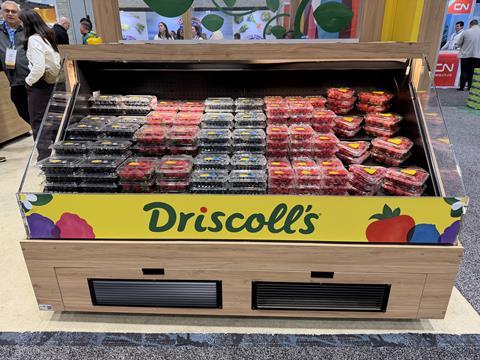
Let’s finish by talking about the recent growth of berry sales. It has been a fantastic journey not only for Driscoll’s but for the category as a whole, and despite these recent headwinds it’s one that seems set to continue. At the Global Food Forum, Soren talked about the category’s growth and suggested that GLP-1 weight-loss medications are playing a role. Do you see evidence of that in your data?
JS: First, last year marked a tremendous milestone when the US berry category surpassed US$10bn in retail sales. Strawberries remain the number one fruit by value in the United States, and berries continue to benefit from a number of broader consumer trends.
Since Covid, we’ve seen a significant increase in consumer focus on health and wellness. People are paying much more attention to the foods they eat and how those foods support their wellbeing.
GLP-1 medications are one part of that broader trend. While I cannot claim a direct causal relationship between their usage and berry consumption, studies show that although people using these medications tend to reduce their overall calorie intake, purchases of fresh fruit generally do not decline and, in some cases, may increase slightly.
Consumers using these medications often say they are looking for more nutrient-dense foods and foods with higher fibre content. Berries align very well with those needs. So while I would not claim a direct connection, berries are well positioned to benefit from these broader health and wellness trends.
There seem to be similarities between Driscoll’s and your former employer Zespri in terms of branding, product development, and consumer marketing. As someone who has worked both in FMCG and produce, how do you expect the Driscoll’s brand to evolve over the next few years?
JS: While there is a great deal we can learn from FMCG, produce is not FMCG. My ambition is not to turn Driscoll’s into something it is not.
What I want to do is help more consumers around the world understand what makes Driscoll’s meaningful and different. I see three important areas of evolution.
First, becoming more consumer-centric. For decades, Driscoll’s has excelled at producing great berries. Now we are building deeper understanding of consumers: what motivates them, what occasions they buy berries for, what benefits matter most to them, and even what our true competitors are, which may not always be other fruits.
Second, becoming more distinctive as a brand. We have extraordinary assets, including our heritage, our breeding programme, our quality standards, and our commitment to delighting consumers. The opportunity is to express those strengths more consistently and in a way that creates a stronger emotional connection with consumers.
We want consumers not only to recognise Driscoll’s as a high-quality berry brand, but to understand what we stand for and why we are different.
Third, broadening the role of the brand in creating value. Historically, produce brands have focused on awareness and recognition. We believe the Driscoll’s brand can create value throughout the entire consumer journey, from initial discovery and desire, through purchase, and ultimately to repeat consumption.
When we do that successfully, it supports category growth, retailer growth and, importantly, better returns for growers.
That is what excites me most. We are starting from a position of strength. We are already one of the most recognised brands in produce and berries remain one of the fastest-growing categories.
The next chapter is about becoming more meaningful to consumers.




Topics
- Africa
- Appointments
- Asia
- Australia
- Belgium
- Berries
- Canada
- Chile
- China
- Consumers
- Egypt
- Environment
- Ethical trade
- Europe
- France
- Fruit
- Germany
- Health
- Laos
- Marketing
- Markets
- Mexico
- Morocco
- Netherlands
- New Zealand
- North America
- Oceania
- Organics
- People
- Peru
- Portugal
- Production & Trade
- South Africa
- South America
- Spain
- Supply
- Sustainability
- United Kingdom
- United States